
According to the largest study conducted on trans and gender diverse youth in Australia (where I live), 48% of young trans people have attempted suicide. Put another way, almost one in two trans kids in this country have tried to kill themselves.
One in two.
I knew this truth before I learnt this statistic. Deep in my body. I knew. Because this truth is muscle memory. It’s the picture of a burnt orange sunset seared into my mind’s eye, how the sky was so brilliant and so red, it looked as if those blackened hills were on fire. And that wide sea, clipped white by a ferocious southerly wind. How wild it all was before me. It’s the way I slowly took off my shoes. And how I paced back and forth from the cliff’s edge, trying to decide how big my run up needed to be. Seventeen years old and counting how many steps it takes to obliterate a life.
You see, I knew this truth before I learnt this statistic because I know what it feels like to believe your body is an unlivable place. I know what it feels like to be so full of dark ocean… so completely swollen with sadness, that all you want is to open… and to feel your chest explode.
I know what it feels like to cry not in the face of death, but in the face of being found…
I didn’t know I was trans when I was found pacing at the cliff’s edge. That word – trans – was not part of my vocabulary, and therefore not part of my imagination.
People talk a lot now about the proliferation of labels and so often I hear it groaned as a complaint. Can’t we just all be human? Why does it even matter what you identify as?
This is easy to say when your identity is the default, and not the one in question. Because when you’re relegated to the margins, these shadow lands are difficult to describe without words that speak specifically to that terrain. How do you carve out the truth of who you are in a world that so often denies you even exist? How do you say, I am here and I am trans, when the headlines keep telling you that being trans is at best, a trend, and at worst, evil, perverted, and a threat to women and children?
Tell me, how do you live in your body when the world at large wants to exile you not only from society, but also from yourself?
In her book, call them by their true names, Rebecca Solnit writes: “naming is the first step in the process of liberation.” To call myself trans, then, is radical, defiant, subversive. It is claiming my own reality. It is saying to the world; here I am in the here and now. I am real. I exist.
I am driving up the east coast of Australia the first time I call myself trans. I’m alone in the car. In fading light, the world passes me in rushes of sap green and burnt umber. I wind down my window and swallow pink sky. Then I say the words, trans… I am trans. And feel my own future unfurl, opening out wide like a sun-baked horizon.
Because the world so often tells trans people that the future does not belong to them. And after spending so many of my teenage years in and out of psych wards, my future was forever shrinking until I reached the point where another breath felt impossible to imagine. I didn’t have language for these formless feelings, but I felt them, anyway with startling severity. There was the intense discomfort in my body and the agitation felt most acutely in still and quiet moments, when I had nothing to distract me from myself.
I don’t doubt that my journey with bipolar was real, but looking back, I wonder how much more effective my treatment may have been if I’d had words like gender dysphoria to describe how difficult it was to exist in my body.
Or if I’d known what transgender meant when I shared a room with another young person who wore men’s underwear and bound their chest with a bandage.
I remember their acid blue hair, and how in the quiet hours we spent together in our hospital room, I felt the blue ache of desire to know all of them. How later, when I was put on medication for bipolar and felt my mania finally stabilise, I conflated that deep and untold yearning with being sick.
How for the next four years, I threw myself into a relationship with a boy, desperately trying to be his girlfriend, and not realising this was a performance until we broke up and I slept with a woman for the first time and felt, between clouds of pink smoke, like I was standing on the wet shore of my new beginning, looking out into open ocean, wind chopped and wild, thinking, oh, this was what I wanted all along. Here I am. I understand it now.
How it was the sweetest joy to realise, through loving her, that the dreams and silent craving weren’t symptoms of being sick. Because she gave me a word that gave shape to my yearning… Queer.
In their book, All About Yves, trans author Yves Rees, writes about reading the mess backwards. When I read their memoir, it made me reflect on how my own becoming has been a series of leaps forward into the dark, with no idea what to expect. Like when I shaved my head for the first time and cried looking in the mirror because I’d never looked so me… how I didn’t know how wrong I’d felt before until suddenly I felt right.
Or how, when I named myself Dylin, a name that comes from the rugged coast of Wales, where my family is from, meaning born of the sea… I felt all that dark sea in me, become warm… ribs pulling apart, my future exploding through my chest like bright white sea foam. Because naming is the first step in the process of liberation. And here I am, tasting the salty joy of naming myself.
It is a radical act, I think, to dream of futures, to claim tomorrow, next year, a decade from now, for your body, when the world says, this future is not for you.
Because the more I’ve leant into my transness, and the more aligned and more myself I have felt on the inside, the more hostile the outside world has become. People will often say, what doesn’t kill you makes your stronger. I think, sometimes, what doesn’t kill you makes you tired.
I have a thinner skin, I think, too. Because I see in the headlines how routinely trans people are accused of grooming children and of corrupting young minds, and though I try my best to ignore those accusations, they seep in… slowly, but surely. So that when something goes wrong in my personal life, like when I’m rejected by someone I love, or when I argue with a family member, all those terrible things people say about trans people rear their ugly heads and the shame swallows me whole. It makes me feel like the newspapers are right about us. It makes it hard to breathe, like I’m being crushed from the inside out.
Rebecca Solnit, in call them by their true names, says also that key to the work of changing the world, is changing the story. And so, I take to the water, and find myself always, writing stories of small streams and deep lakes, and rivers emptying out into whole seas. Perhaps because in water, I feel strongest, and most myself. In water, I am wholly embodied, like this flesh is sacred, like I am the window that’s letting the light in.
Because in water as clear as wanting, I arrived here, to survive myself. I became here, to survive myself.
Now I am trans, as in, transforming.
Trans, as in oceanic.
Trans, as in transcendent.
Now I am here.
Deep sea shimmering. Slicked hair and fish scales for skin. Here I am.
I am here.
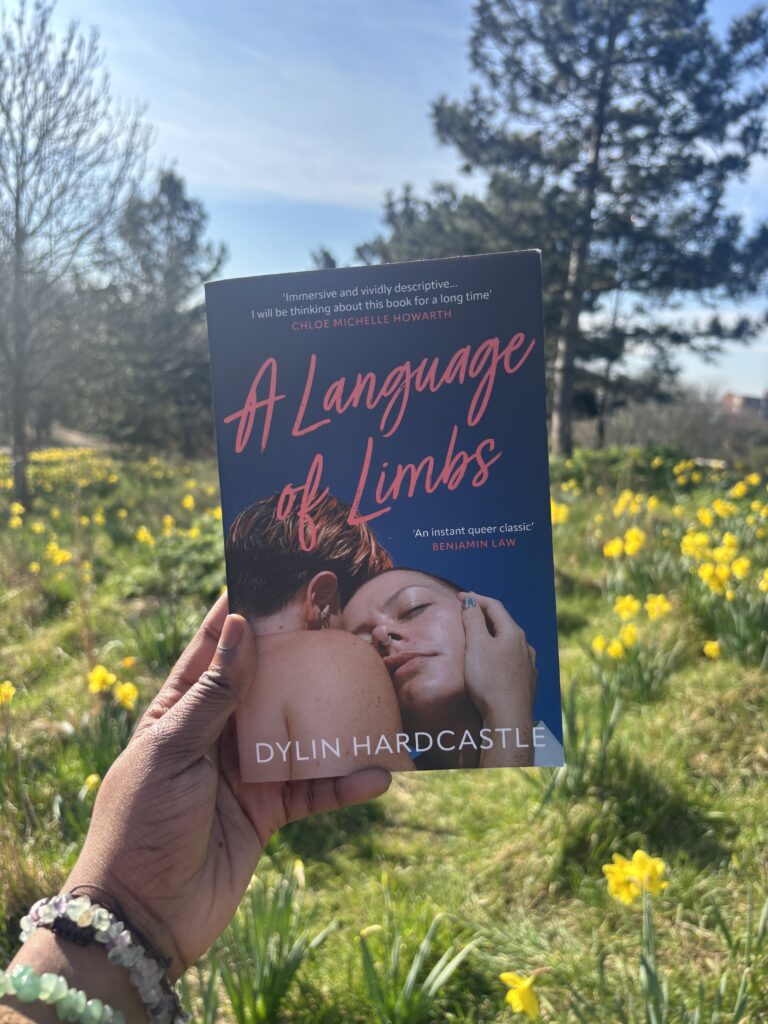
A Language of Limbs by Dylin Hardcastle is available for pre-order here