
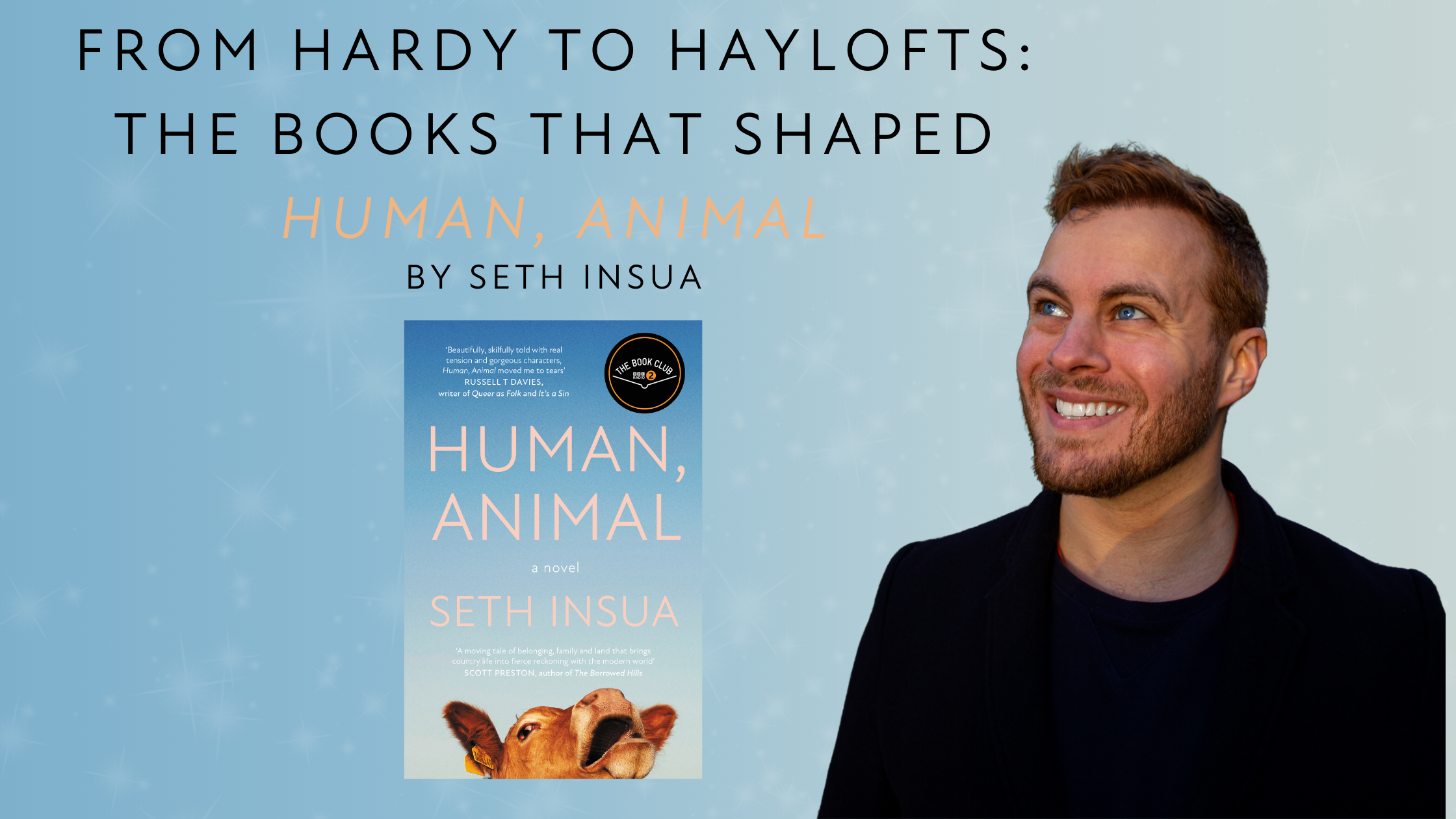
So, my debut novel Human, Animal is finally hitting the shelves! It explores the complex terrain of tolerance in a world increasingly defined by its divisions. The seeds of this story were sown in my own childhood experiences. Growing up in the countryside, surrounded by animals, I was immersed in the sights, sounds and scents of rural life. From playing in haylofts (despite my terrible allergies) to building dens in the woods, nature was both a playground and a stark reminder of life’s fragility. I vividly remember the brutal efficiency of a magpie decapitating my pet duckling, Perdi, a visceral experience that instilled in me a real appreciation for nature’s sublime yet terrifying power.
This intimate connection to the rural world fuelled my desire to portray the hardships and beauty of agricultural life with lyricism and authenticity. My research into dairy farming was extensive, involving conversations with farmer friends, countless articles and videos and a deep dive into historical accounts. I was particularly struck by the transformation of dairy farms over the twentieth century, from the celebrated People’s War to the pressures of modern industrialisation. This contrast became central to my narrative, allowing me to explore the characters of Stefan and Maggie, each a maverick in their own right, against the backdrop of a changing world. I’m very grateful to the authors whose works enriched my understanding of farming life, including Sally Urwin, Adam Henson, John Lewis-Stempel, Richard Cornock, John Connell, Roger Evans, Joan Bomford, G. Walter Wright and Rosamund Young. The novel’s historical thread was inspired by journals of my English grandmother, Mary Summerhays. Typing and editing her writings gave me a unique window into her life and the era she inhabited. My great-uncle John’s experiences as a spy in Italy during WWII, and the rumours of a wartime romance, also provided rich material, particularly for the character of Stefan. My research into this period, including the works of Christiane Wienand, Pamela Howe Taylor and Alan Patrick Malpass, provided valuable context and detail.
Ruth Ozeki’s A Tale for the Time Being influenced Human, Animal through its exploration of interconnectedness and empathy. Ozeki’s masterful weaving of disparate voices and perspectives across time and cultures inspired me to create a narrative that explores the complex web of relationships within a family. Like Ozeki, I sought to highlight the power of human connection, even across seemingly insurmountable divides, and the importance of understanding the stories of others. The gentle yet profound tone of A Tale for the Time Being also served as a model for the emotional landscape I aimed to create in Human, Animal, where moments of heartbreak and hope intertwine.
Iris Murdoch’s The Bell, with its exploration of flawed characters yearning for freedom and struggling against their circumstances, strongly resonated with me when I read it just after finishing uni. The novel’s focus on a community grappling with complex relationships, hidden desires and the tension between individual needs and societal expectations, influenced my portrayal of the characters in Human, Animal and their struggles within the confines of their rural setting and family dynamics. The heart of my story lies in a family torn apart by differing beliefs and identities. This aspect of the novel is informed by my own experiences as a queer person. While Human, Animal is not autobiographical, it draws on my understanding of the challenges and triumphs of navigating family relationships, particularly in the context of coming out. I wanted to portray George and Sandra not as villains, but as complex individuals struggling under immense pressure, fiercely protective of their family and their way of life. Like Murdoch, I aimed to create a nuanced portrait of individuals wrestling with moral ambiguities and the search for meaning in their lives.
Thomas Hardy’s influence on Human, Animal is rooted in his exploration of Darwinian principles within a rural setting. Like Hardy, I examine how characters struggle to adapt to a rapidly changing world, and how those who are not ‘pre-adapted,’ to borrow a term from evolutionary biology, face significant challenges – even tragic consequences. This idea of societal evolution, where certain individuals and ways of life are rendered vulnerable by progress, is central to the novel’s themes. Just as Hardy’s characters often find themselves at odds with the forces of modernity, the characters in Human, Animal grapple with the shifting landscape of agriculture, animal rights and social norms, highlighting the struggle for survival in a world that is constantly evolving.