

By Stephanie Feldman
1. Oneiromancy: divination by dream
I used to have vivid dreams – different, in some unnameable way – about visiting with my deceased grandfather. I’m agnostic about the supernatural – like Fox Mulder, I want to believe, but like Dana Scully, I don’t, not really – but I felt compelled, comforted, and chased by these dreams. They became the only autobiographical sequence in my first novel, in which the main character receives ghostly visits from her own deceased grandfather. He has a message, too, because he’s a character in a novel; and because she’s a character in a novel, the protagonist decodes the message by the story’s end.
The novel, then, was a kind of escape from the weirdness of life. Sure, my fiction is weird, but it has structure and logic. (Enough, anyway; don’t @ me.) In real life, my dream was just the random shuffling of neurons. In my book, dreams meant something.
My real-life dreams didn’t confirm the beyond and they didn’t predict the future, either, which was that my writing would become the weirdest mystery of all, each page another uncanny missive, ignored until it was too late.
2. Grammomancy: divination by writing individual letters
Not to be confused with graphology, which is divination by studying handwriting.
Neither of these is telling the future by crafting narrative – sculpted scenes, characters with punchy dialogue. If we could tell the future, maybe we wouldn’t write stories at all.
In the post-2016 era, when making up stories felt personally urgent but socially irresponsible, I started writing another novel. Writing even as I wondered: who cares about my dumb novel when democracy is buckling, when a tweet may trigger a nuclear missile? For the first time in my life, my fear of the future was overwhelming, but still I scratched and scrawled, hoping the words might mean something, something that mattered.
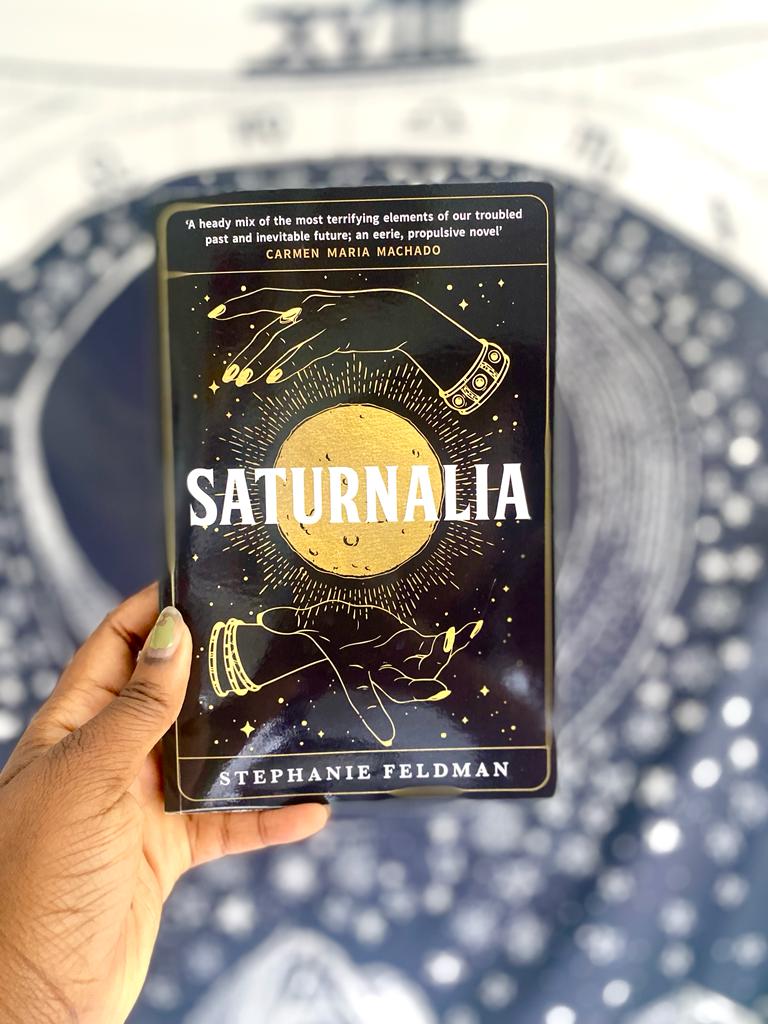
The first sentence of that novel, Saturnalia: ‘It’s not the life I planned for, telling fortunes during the end of days, but clients are plentiful.’
3. Retromancy: divination by looking over one’s shoulder
For two years, I wrote stories featuring catastrophic weather events: a husband killed in a flash flood; a ghost that dissolves into a terrifying island storm; a gothic mansion battered by a tornado. A small part of me wondered if it was becoming a bit of a crutch. Most of me was worried about other things, like the pandemic and virtual school and elections and employment.
The destructive weather trope was, at first, just a hint in Saturnalia. The novel follows a single night in the fortune teller’s life, a winter solstice celebration in a climate-wrecked Philadelphia. At the beginning of the novel, she observes that the skyline has been fractured by a tornado.
There’s something ghastly and satisfying about sending a psychic wrecking ball through your own home. I grew up in Philadelphia and live there now – well, in the suburbs, though I’m writing this at my parents’ house, my temporary address, within city limits.
Anyway, these were the very pages I was editing in the hours before the tornado came down our street, the same pages I shoved in a bag, my youngest child – too old, but still light enough, and barefoot – on my hip and my oldest close behind. After the tree came through the ceiling and the windows exploded. After my husband made it back inside the house, just as the winds whirled the yard into ruins; he could have died in the sudden storm, like the husband in the story I drafted two years before, but he lived, the sheer luck of seconds.
‘After, after…’ A story to avoid those minutes. Tell it like it happened. Dirty dinner plates as the rain scrubs the world from the windows. The trill of our smartphones. The power going out; the generator coming on; the crash and the generator going out. Herding the children into the central staircase. Herding them back as they drift away to try the television again, not realizing they should be afraid. The freight train sound. Our ears popping. The house shaking. The whistle of the children’s keening, a fearful sound they had never emitted before, and me repeating, ‘It’s OK, everything’s fine, we’re safe,’ though I had no idea what had happened, or what might happen next.
The four of us fled to a neighbor’s basement – our house doesn’t have one – and before the internet went out, I sent an adrenaline-deranged email to a friend. Well, I wrote, it turns out I’m a witch. I wrote a tornado into existence. I think my house is gone but I’m OK.
A couple days later, we would confirm that the house could be repaired, and a couple days after that, I realized I wasn’t OK at all.
Saturnalia by Stephanie Feldman
4. Cartomancy: divination by cards, as in the tarot or oracle deck
I like reading the cards, but I’m no witch. I didn’t conjure a tornado with my prose. I know the cards are a mirror reflecting our own concerns, not a portal into other times and other minds. They present a rich jumble of symbols and we see what we want or need to see.
That’s not a drag on card-reading – a mirror, a focused and guided reflection on your circumstances and thoughts, can be very useful. Most of the time, our minds are like little cubicle farms in our skulls; each neuron cluster working on related projects, but also ignoring each other’s emails.
Two weeks before the tornado, I told my husband that my half-educated opinion was that we were in a relatively good place, geographically. Fires, droughts, hurricanes – not really Mid-Atlantic phenomena. Sure, water shortages and refugee surges will affect all of us, but in terms of our immediate safety, we in southeastern Pennsylvania might be among the best situated in the US.
‘Except for tornados,’ I said. ‘The warnings are growing more common. And we don’t have a basement. But I’m sure I’m just being neurotic.’
I had the same neurotic thought when we put an offer on the house almost a decade before. No basement. That meant no playroom for the kids – no place to shunt off their toys, that is – but also no refuge. It’s OK, I told myself. It’s not like a basement really matters, not like Pennsylvania gets tornadoes.
The figment of the tornado kept coming back, is what I mean. When I dismissed it, it pushed into my writing, weeds through concrete, and still I ignored it. Just a thematic thread, just a plot device, until suddenly I realized I had created a library of the future. Not clairvoyance, but educated predictions, from scientists and my own observation.
Well, maybe not fair to say I ignored it. Yes, I was a bit ashamed of these fears – always a worrier, with a hysterical imagination. The truth is, though, there was just nothing I could do but wait and see if they came true.
See also: Phobomancy, divination by fear.
5. Hydromancy: divination by rainwater
Thunder, a sudden gust of wind, trees swaying and hissing outside the windows – they make the kids cry. I prepare them: it’s going to rain tonight, there might be thunder, we’ll be together. I reassure them, though my heart is racing, too: it’s just a little wind, it’s going to stop soon. I lie to them: it won’t happen again.
We don’t have to divine the longer-range future. We know how the climate is changing, and why, and how to fix it; we can’t know for sure, but we have reason to believe that humanity will not enact that fix.
One of the men cleaning out our waterlogged and splintered house told me a story about another client in our region. Years ago, she was also hit by a tornado and it took four months to repair her home. The day after she moved back in, a second tornado hit. They came back and cleaned out her house again. A year later, she was hit by a third tornado, a sibling of our own, which FEMA named ‘Remnants of Hurricane Ida’.
‘Don’t tell me that!’ I wailed into my mask. We were both wearing masks, because of the dust and, of course, because of the lingering pandemic.
Then he told me a story about another client in the mountains, whose home was stalked by an enormous coyote, which piled carcasses in an outbuilding. I enjoyed that one. I live in Philadelphia. We don’t have coyotes here.
6. Dendromancy: divination by trees
Our neighborhood was sort of the usual suburban tableau, except for the hundreds of old growth trees. They made it look cozy and fairy tale-like, which comforted my snobbery when I first arrived after a lifetime of living in cities, and comforted my despair during the pandemic. For months, I took long, long, very long walks beneath those trees, my only escape from the house, where we lived and worked and schooled and where I wrote stories about people fighting floods and storms. (But not fighting viruses – it was escapism!) My sense of home expanded to include the entire neighborhood; the trees were an extension of our house, where we were all safe.
This only became clear to me afterwards. You might say I read it, reflected back to me, in the trees broken by the tornado. Everywhere, enormous trunks, boughs, debris piles on the ground, and pillar-sized splinters spearing the sky. The world was suddenly bright and hot and ugly.
A pivotal moment in time – before the tornado and after, when there were trees and when there weren’t. (Aren’t.) But this demarcation of eras is another imposition, another attempt to create patterns. There are no singular tipping points. It’s an endless flux; a long slow slide.
I felt like I missed the signs until it was too late, even if there was nothing I could have done. But what if I’m wrong about it being too late – what if I’m in another, oblivious before-time?

7. Pareidolia: not divination at all, but the phenomenon by which humans recognize patterns – or, mostly, faces – in random assemblies of shapes
Here’s a thought experiment, one you might have considered yourself: do you want to know how you’ll die? Each answer has pros and cons. In the wake of the 2016 election, I was absolutely desperate to know the future – to know, I guess, that there was a future and that it would be OK. Children uncaged, courts unfucked, voting rights returned. In the wake of the tornado, I thought I finally saw a very real possible future: this is how I might die – a shrill alarm, a drop in pressure, and then an obliterating crash. I felt a kind of grim acceptance.
If I do die in a tornado, or some other extreme weather event we can no longer call freak or fluke, you might look over your shoulder, back at this essay, and think I was a fortune teller.
And maybe I am. Maybe I do have psychic powers. Incredibly useless psychic powers.
I think, though, I’m just an ordinary person. I’d like to see the future – winning lottery numbers, planes to avoid, and so on – but more than that, I just want the present to matter. I want my dreams, love, and fears, the actions I take, the troubles I encounter – I want them all to have meaning. I don’t want my small dramas to be only small dramas before the inevitable obliteration.
That’s the fortune I want: a wealth of meaning.
8. Chronomancy: divination not by time, but of time; to determine the lucky and unlucky days
I’m writing from the future, after the exile in which I first set down these words. I’m back in my home and in my right mind. I’m thinking about something funny that happened. Right after the storm, I stood with a neighbor and looked out onto the block – heaps of wood, downed power lines, crumbled rooftops.
‘We’re really lucky,’ he said.
‘Yes,’ I agreed. ‘It could have been worse.’ What I meant: we could have died. My husband, steps ahead of the tree limbs that speared five feet into the earth; my youngest daughter, huddled on the stairs instead of lying in her bed, which caught a falling branch.
My neighbor looked at me. ‘No,’ he said. ‘I am lucky. You’ – he gestured to the tree sunk in my roof – ‘are not lucky.’
He had a point: we could have been luckier.
But here we are, healthy and intact and back home, with a really great new sofa to replace the one lost to water damage. Sometimes, it’s like the last seven months away never happened; sometimes it’s like the tornado was yesterday.
The protagonist in Saturnalia, the card-reader, believes telling fortunes is a scam. It’s just a game, she reassures herself, again and again. The reader, though, suspects she’s wrong.
In reality, we can never know. Not just what the future holds, or if we might glimpse it, but what mysteries animate our lives. Maybe we can at least locate fortune and divinity, whatever they mean, here in the present.
Life is, really, an eternal present.
If I draw a card from my tarot deck, right now, it’ll confirm that theory. That’s what I’ll see, because it’s what I need to remember.